Editorial details
Suggested citation
Salazar Hortua LF. The Doctor, the Patient, and the Chat [Internet]. 2026-10-06. Available from: https://luissalazar.md/en/articles/el-medico-el-paciente-y-el-chat/
Notices
- Opinion article for educational purposes; not individual medical advice. The scene is fictional.
AI use
Text written by the author. AI tools supported research, spelling and citation corrections, and adaptation into English.
Inevitably, by now we have all heard about artificial intelligence. In fact, in an American Medical Association (AMA) survey1, 81% of the physicians surveyed said they used AI in their work. The most commonly reported uses were summarizing (39%), preparing instructions and care plans or progress notes (30%), and documenting medical records or consultation notes (28%). Apparently, we have already integrated it into our work routines. Recently, Sam Altman, CEO of OpenAI (the creator of ChatGPT), before the United Nations Security Council2, said: “AI can either be more like a new Renaissance of creativity and discovery, or more like a new Industrial Revolution of upheaval and disarray.”
The first possibility holds the promise of empowering human beings. In a review of AI applications in medicine, Fahim and colleagues3 describe how these tools can support diagnosis, treatment planning and patient monitoring. They suggest that, by complementing professionals, AI can reduce errors, optimize resources and improve care, but make that promise conditional on clinical oversight and training for those who use it. So far, it seems we agree with Sam. However, an uncomfortable thesis has recently been proposed that makes us think about the second possibility: Ezekiel Emanuel and colleagues, in JAMA4, propose that, toward 2030, autonomous AI could surpass not only the physician, but also the physician who works with AI, in some cognitive tasks in medical care.
Where does this come from? In a trial by Goh and colleagues5, published in 2024, 50 physicians were randomly assigned to solve up to six written clinical cases with the usual resources, with or without access to GPT-4 (in 2026 we are on GPT-6 Astra). Evaluators who were unaware of the group scored the proposed diagnoses, the arguments for and against, and the next evaluation steps. The median diagnostic reasoning score was 76% with AI and 74% without it, with no statistically significant difference; in a separate exploratory analysis, GPT-4 working alone scored 92%. The researchers note that how the model is asked could explain part of that difference: giving the physician access to it is not the same as teaching them to make the most of it.
This hypothesis has continued to be evaluated recently. A meta-analysis of 106 experiments, at least 20 in medicine, found that combining humans with AI worsened performance when the machine alone was already superior.6 Another analysis of 52 clinical studies found that AI could improve doctors’ performance, but that, overall, this collaboration did not outperform whichever achieved better results on its own, whether the doctor or the AI.7 These results challenge an assumption: it is not proven that the AI-assisted physician is the best option. Autonomous AI could offer better results in five cognitive tasks and be ready for some clinical workflows by 2030.4 However, most of these comparisons remain simulations, not complete clinical consultations.
The five cognitive tasks in which AI could outperform clinicians4
| Task | What it involves |
|---|---|
| Obtain clinical information | Symptoms, history and medications |
| Formulate differential diagnoses | Identify the possible causes |
| Select tests | Decide which studies to order |
| Recommend treatments | Propose options consistent with the guidelines |
| Manage chronic diseases | Monitor and adjust treatment |
I’m going to step out of my role as a physician-statistician for a second. These machines are increasingly capable of doing everything: what does that mean for those of us who chose medicine for the science behind caring for others?
From childhood magic to the chat
Since I was little, obsession and curiosity have been with me. It started with my nona’s (maternal grandmother’s) home remedies, which somehow always made me feel better. I had no idea how they worked, but they did their job. Over time, that curiosity led me to become a doctor. However, when I graduated I ran into the “healthcare system”: in daily practice, being a doctor largely came down to paperwork, meticulous medical records and prescribing software. Little magic. Apparently, the only way out to improve day-to-day life was to continue my training with a specialty. There are many to choose from, all with fascinating fields and most with the promise of a better salary (Tempting) or a better quality of life (Even more tempting). I found it hard to choose: I felt that each path brought me closer to some questions and farther from others.
One day between late 2022 and early 2023, a tool appeared, a chat, with a challenging “Ask me anything.” I did, and to my surprise, it seemed to know everything. Or at least, everything I asked it. It answered well enough to surprise me. Or to fool me? I felt that curiosity coming back: how did it work? I wanted to understand it, so I went into statistics and data science. Today I have a master’s degree in that field. Yet, even knowing a little more about these models, they still amaze me every day. Having one of these chats at hand while I practiced medicine seemed to solve many of the problems I had seen in practice. Then I heard this story from a friend of a friend.
The answer arrives before the question
When a person arrives at a consultation with their tests (if they bring them), they no longer arrive only with the interpretation a friend of a friend who is a doctor gave them over WhatsApp, it turns out they now also bring the chat’s interpretation. The silence in the medical consultation is different, still awkward, but now there is this air of judgment.
You can almost hear the questions the patient is asking themselves: “Will they tell me what I already read? Will they see something different from what the chat knows?” I have seen colleagues receive the tests and review them in detail according to their knowledge and the thresholds. When there are too many tests for the few minutes of the consultation, or they want to add them quickly to the medical record so they can continue the consultation, they take photos and upload the PDFs to the chat. They ask it rigorous questions within their area of knowledge, wait a few seconds and receive a very well-structured answer. Usually, the answers are very good, very close to what you, as a specialist, would give after many years of study. Sometimes they even point out things that might have been overlooked.
And honestly, I understand my colleagues: it has happened to me too. We fall into copying the text, changing a couple of things and pasting it into the medical record. Then we explain to the patient what the chat has already helped us write.
In this story, it seems the doctor used a tool and continued the consultation. But the patient already came with an answer and now hears another that also went through the chat. Who used whom? The doctor received an answer; the chat, new information.
This scene is fictional (almost).89
Too much information, not enough space to make sense of it
This story led me to reflect on these machines that seem to know how to do everything. They have many advantages in their favor: their speed, their mathematics and their computation. We, on our side, have emotions, intuition and empathy. It seems we don’t compete; we might even complement each other. But the evidence suggests that we must learn to use them correctly. Yet it is very difficult to keep up with them: every month a new model appears, a different algorithm, an even more astonishing application. We seem to be running toward a future we don’t quite understand.
On this, even Dario Amodei, CEO of Anthropic, the company behind Claude, calls in We Must Pace the Frontier10 for moderating the pace of progress so that safety can keep up. And Jacob Coxon11, a researcher who worked at OpenAI and Anthropic, went further: when announcing his resignation on X (Twitter), he wrote that those who build this technology believe it could kill us all before the end of the decade. Between the promises of what AI can do for us and the fear of what it could do to us, we feel lost.
“We have grown accustomed to certainty, speed and immediate rewards. Sometimes, a doctor's value lies in pausing: listening, asking one more question and recognizing what still doesn't fit. Intuition does not replace evidence; it can point to where we need to keep looking”
Read image description in English
“We have grown accustomed to certainty, speed and immediate rewards. Sometimes, a doctor's value lies in pausing: listening, asking one more question and recognizing what still doesn't fit. Intuition does not replace evidence; it can point to where we need to keep looking”
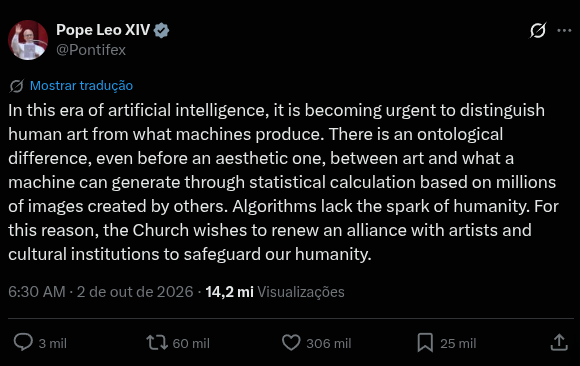
A friend of a friendThat concern about what we humans are contributing also appears outside medicine. In a post about art and artificial intelligence, Leo XIV insists on distinguishing human creation from what machines produce. Context for the reflection12.
Read screenshot transcript
In this era of artificial intelligence, it is becoming urgent to distinguish human art from what machines produce. There is an ontological difference, even before an aesthetic one, between art and what a machine can generate through statistical calculation based on millions of images created by others. Algorithms lack the spark of humanity. For this reason, the Church wishes to renew an alliance with artists and cultural institutions to safeguard our humanity.
Returning to medicine, in a recent perspective article published in 2026 in The Lancet Digital Health13, Wu and colleagues point to a gap that runs through this discussion: a model can achieve good results on tests and yet not translate into a benefit for patients. To connect technological development with clinical practice, they propose a career pathway they call “clinician–AI scientist”: a professional who integrates clinical, technical and research knowledge to identify care needs, evaluate these tools and guide their responsible implementation.
That proposal helps me give a name to the path I want to build. I would like to contribute from medicine and statistics to understanding what each tool does and how to use them correctly, and keep sharing what I learn in this space. We will look at what evidence supports them and what is missing before putting them into practice.13
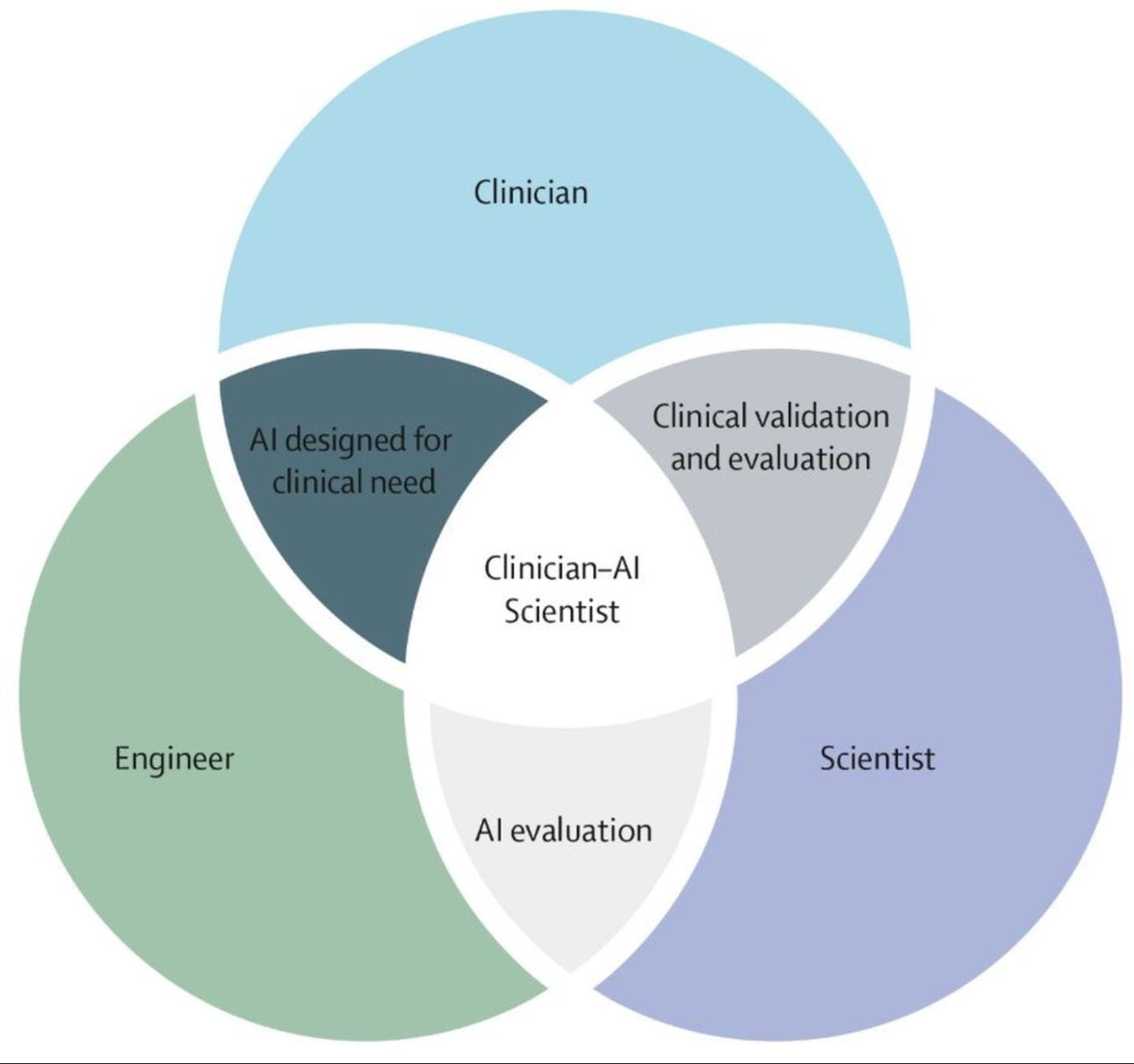
The multiple identities and capabilities of the clinician–AI scientist. Figure by Wu and colleagues, The Lancet Digital Health (2026). The original English is preserved. Source: original article. License CC BY 4.0.
That is the idea behind this editorial at luissalazar.md, where the text MUST be human: writing lets us think with others across time. In 1950, Turing14 put a question in writing that still accompanies us: “Can machines think?” We can return to it, discuss it and ask ourselves other questions. That is the idea: to keep thinking together. I write every word you will find in these publications (all use of AI is disclosed). This space is not a collection of quick answers, but a place where you can see how we arrived at a question and what we did to answer it. I’m not against using AI. It led me to study statistics and data science precisely because I wanted to understand it better. But the speed of this new era cannot take away our opportunity to learn and keep up closely.
This is the beginning. Welcome. Subscribe to the newsletter; here, we’re part of the 1% who want to use these new tools with the rigor our patients deserve. Every week, on Sundays, a new article, course, skill. In the next one, we will solve the problem the colleague in the story has: we will study how to build an AI agent and how to give it a longitudinal memory of learning and knowledge.
Sincerely,
Luis.
References
American Medical Association. More than 80% of physicians use AI professionally: AMA survey [Internet]. 2026. [cited 2026 Oct 4]. Available from: https://www.ama-assn.org/practice-management/digital-health/more-80-physicians-use-ai-professionally-ama-survey. ↩
United Nations. Ongoing Efforts to Create Powerful AI a “Race Where Everyone Loses”, UN Expert Tells Security Council, as Members, Tech Leaders Debate Governance Issues [Internet]. [cited 2026 Oct 4]. Available from: https://press.un.org/en/sc/16462.doc.htm. ↩
Fahim YA, Hasani IW, Kabba S, Ragab WM. Artificial intelligence in healthcare and medicine: clinical applications, therapeutic advances, and future perspectives. Eur J Med Res. 2025;30(1):848. doi: 10.1186/s40001-025-03196-w. Available from: https://pmc.ncbi.nlm.nih.gov/articles/PMC12455834/. ↩
Emanuel EJ, Baker-Butler A, Khosla N, Khosla V. Will Autonomous AI Exceed AI-Aided Physicians as the Best Medical Care? JAMA. 2026;336(11):915–918. doi: 10.1001/jama.2026.15380. ↩ ↩ ↩
Goh E, Gallo R, Hom J, Strong E, Weng Y, Kerman H, et al. Large Language Model Influence on Diagnostic Reasoning: A Randomized Clinical Trial. JAMA Netw Open. 2024;7(10):e2440969. doi: 10.1001/jamanetworkopen.2024.40969. ↩
Vaccaro M, Almaatouq A, Malone T. When combinations of humans and AI are useful: A systematic review and meta-analysis. Nat Hum Behav. 2024;8(12):2293–2303. doi: 10.1038/s41562-024-02024-1. ↩
Liu P, Zhang J, Chen S, Chen S. Human-AI teaming in healthcare: 1 + 1 > 2? npj Artif Intell. 2025;1:47. doi: 10.1038/s44387-025-00052-4. ↩
OpenAI. What if I want to keep my history on but disable model training? OpenAI Help Center [Internet]. [cited 2026 Oct 4]. Available from: https://help.openai.com/articles/8983130-how-does-chatgpt-use-my-data. ↩
Castelvecchi D. Who gets credit in the AI era? OpenAI maths bombshell sparks debate. Nature. 2026 Sep 17. doi: 10.1038/d41586-026-02910-w. Available from: https://www.nature.com/articles/d41586-026-02910-w. ↩
Amodei D. We Must Pace the Frontier [Internet]. 2026 Sep. [cited 2026 Oct 4]. Available from: https://darioamodei.com/post/we-must-pace-the-frontier. ↩
Yeo A. Anthropic researcher quits, calls AI an existential threat to humanity. Mashable [Internet]. 2026 Sep 9. [cited 2026 Oct 4]. Available from: https://mashable.com/tech/anthropic-ai-researcher-quit-ethics-safety. ↩
Vatican News. Pope Leo: the Church needs artists [Internet]. 2026 Oct 2. [cited 2026 Oct 4]. Available from: https://www.vaticannews.va/en/pope/news/2026-10/pope-leo-the-church-needs-artists.html. ↩
Wu Y, Ong AY, Chen H, Yang GD, Tham YC, Keane PA, et al. The clinician–artificial intelligence scientist: a proposed career pathway in medicine. Lancet Digit Health. 2026:101077. doi: 10.1016/j.landig.2026.101077. ↩ ↩
Turing AM. Computing Machinery and Intelligence. Mind. 1950;LIX(236):433–460. doi: 10.1093/mind/lix.236.433. Available from: https://people.csail.mit.edu/brooks/idocs/compmach.pdf. ↩